As long as you swap out the vegetable oil for avocado or olive oil and maybe reduce the honey (if you’re worried about carbs), this charred Brussels sprout and leek Korean-style salad looks quite good.
“Mark, you always offer a balanced and thoughtful opinion and I appreciated your summation here today. It’s why I’ll continue to follow you! I’ve been eating a carnivore diet for 8 months now and have CURED Type 2 diabetes, arthritis, IBS, and depression. My cholesterol is through the roof, but I’m not alarmed. At 65, I’m experiencing the kind of optimal health I dreamed of in my 20s and 30s.”
Aspirin has been called a wonder drug. And it’s easy to see why.
It’s inexpensive, its side effects are well-known and generally minor. And since it was developed in the 1890s, it’s been shown to provide a number of potential benefits, such as relieving pain, bringing down a fever, and preventing heart attacks and strokes. Over the last 20 years or so, the list of aspirin’s potential benefits has been growing. And it might be about to get even longer: did you know that aspirin may lower your risk of several types of cancer?
Studies of aspirin and cancer
A number of studies suggest that aspirin can lower the risk of certain types of cancer, including those involving the
The evidence that aspirin can reduce the risk of colon cancer is so strong that guidelines recommend daily aspirin use for certain groups of people to prevent colon cancer, including adults ages 50 to 59 with cardiovascular risk factors, and those with an inherited tendency to develop colon polyps and cancer.
And what about breast cancer? A number of studies in recent years suggest that breast cancer should be added to this list.
Studies of aspirin and breast cancer
One of the more convincing studies linking aspirin use to a lower risk of breast cancer followed more than 57,000 women who were surveyed about their health. Eight years later, about 3% of them had been newly diagnosed with breast cancer. Those who reported taking low-dose aspirin (81 mg) at least three days a week had significantly fewer breast cancers.
Regular low-dose aspirin use was associated with a 16% lower risk of breast cancer.
The reduction in risk was even greater — about 20% — for a common type of breast cancer fueled by hormones, called HR positive/HER2 negative.
No significant reduction in risk was found among those taking regular-dose aspirin (325 mg), or other anti-inflammatory medications such as ibuprofen.
Another analysis reviewed the findings of 13 previous studies that included more than 850,000 women and found
a 14% lower risk after five years of taking aspirin
a 27% lower risk after 10 years of aspirin use
a 46% reduction in risk after 20 years of aspirin use.
How does aspirin affect breast cancer risk?
These studies did not examine why or how aspirin might reduce breast cancer risk. So we really don’t how it might work.
In animal studies of breast cancer, aspirin has demonstrated anti-tumor properties, including inhibiting tumor cell division and impairing growth of precancerous cells. In humans, researchers have observed an anti-estrogen effect of aspirin. That could be important, because estrogen encourages the growth of some breast cancers. It’s also possible that aspirin inhibits new blood vessel formation that breast cancers need to grow. And the particular genetics of the tumor cells may be important, as aspirin’s ability to suppress cancer cell growth appears to be greater in tumors with certain mutations.
Now what?
It’s too soon to suggest that women should take aspirin to prevent breast cancer. Studies like these can show a link between taking a medication (such as low-dose aspirin) and the risk of a particular condition (such as breast cancer), but cannot prove that aspirin actually caused the reduction in breast cancer risk. So we’ll need a proper clinical trial — one that compares rates of breast cancer among women randomly assigned to receive aspirin or placebo — to determine whether aspirin treatment lowers the risk of breast cancer.
Warning: All drugs come with side effects
Keep in mind that all medications, including aspirin, can cause side effects. While aspirin is generally considered safe, it can cause gastrointestinal ulcers, bleeding, and allergic reactions. And aspirin is usually avoided in children and teens, due to the risk of a rare but serious condition called Reye’s syndrome that can harm the brain, liver, and other organs.
Stay tuned
Low-dose aspirin is often prescribed to help treat or prevent cardiovascular disease, such as heart disease and strokes. A 2016 study estimated that if more people took aspirin as recommended for cardiovascular disease treatment or prevention, hundreds of thousands of lives and billions of dollars in healthcare costs would be saved. That might be an underestimate if the drug’s anti-cancer effects are confirmed. But aspirin is not beneficial for everyone — and some people need to avoid taking it. So, ask your doctor if taking aspirin regularly is a good idea for you.
Shalyse Olson knows there are risks associated with sending her children back to school during the coronavirus pandemic, but the mother of four in Salem, Oregon says virtual learning “has been nothing but frustrating and sad.”
Olson, whose children are enrolled in kindergarten through 10th grade in Salem-Keizer Public Schools, says she understood the need for remote learning initially, when the pandemic closed schools abruptly and forced teachers, students and parents to find ad-hoc workarounds from home. “All of a sudden it was like, ‘This will have to be good enough for now.’ And it was for a few weeks at the end of the year,’” says Olson.
“But now, others are finding ways to do this safely. And we need to get on board and catch up, or it’s going to be a hard one to recover from.”
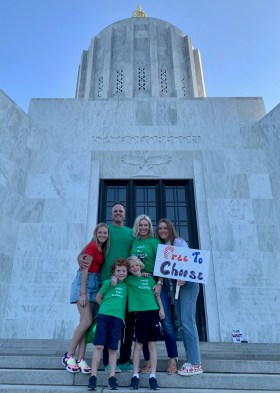
Courtesy of Shalyse OlsonShalyse Olson stands with her husband, Brian, and four children at the state capitol in Salem, Oregon during a rally.
Arecent analysis of 106 school district plansby the Center on Reinventing Public Education found that just 10% were in-person at the beginning of September, but 55% of those districts are planning to be in-person by November. A recentWashington Post surveyof the country’s 50 largest school districts found that 24 have resumed in-person learning for large groups of students, and 11 others plan to in the coming weeks.
Chicago Public Schools, for example, announced a phased plan for returning to school, which drew pushback from the Chicago Teachers Union, which called the plan “reckless” as cases surge in the city. But district CEO Janice Jackson said she was “not throwing in the towel on in-person instruction.”
San Francisco Mayor London Breedurgedthe city’s school district on Oct. 16 “to do what needs to be done to get our kids back in school.” “The achievement gap is widening as our public school kids are falling further behind every single day,” Breed said, noting that “parents are frustrated and looking for answers.”
<strong>“We’ve seen around the country, and in almost every state, that cases are going up right now.”</strong>But on Tuesday, the district’s superintendent said the schools would not reopen until 2021, citing limited COVID-19 testing capacity,the San FranciscoExaminerreported.
Such disputes are playing out across the country as parents realize that remote learning is likely to last far longer than they imagined. Some express frustration that they can go to restaurants and into shops, yet their children cannot go to classes. Others see remote learning as the necessary response to a virus that has not been brought under control.
As the Trump administration plays down the pandemic’s gravity, school districts have largely been left to figure things out on their own. (Education Secretary Betsy DeVos said Tuesday that it’s not up to the federal government to track school districts and their coronavirus infection rates.) Parents have resorted to citing individual anecdotes as evidence of the success or failure of reopening schools.
“We’ve seen around the country, and in almost every state, that cases are going up right now, that we’re not quite at the peak where we were this summer, but we’re heading that way,” says Tara Smith, a professor of epidemiology at Kent State University College of Public Health, whochose remote learning for her own son, a first grader. “So to open up schools again right now, I think, is the wrong choice.”
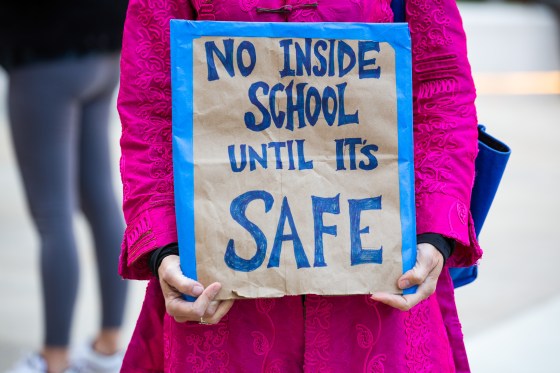
Paul Frangipane—Bloomberg/Getty ImagesA parent holds a sign reading “No inside school until it’s safe” during a protest outside Murry Bergtraum High School in New York City on Sept. 21, 2020.
People under 18 represent 10.9% of COVID-19 cases in the U.S.,according to the American Academy of Pediatrics and the Children’s Hospital Association.Children, especially the youngest, seem to be less likely than adults to get seriously sick or die from the virus. And there is still debate over how frequently children spread the virus; recent studies and case reports provide evidence that transmission from children is possible.Teenagers are more likely than young children to be infected,according to the Centers for Disease Control and Prevention, which is why many schools have prioritized in-person instruction for the youngest learners first.
While COVID-19 cases haverisen among childrenin recent months, it’s not clear that those infections stemmed from schools, but the uptick could reflect spread of the virus in the community at large.An unofficial datasetcrowdsourced by Brown University economist Emily Oster suggests that schools tend to reflect the community rate of infection.
Information, and tracking, still lacking
During arecent briefing on school reopeningsby the Infectious Diseases Society of America, Dr. Wendy Armstrong, an infectious disease expert at the Emory University School of Medicine,said that was “encouraging.” But Armstrong noted the dataset is based on schools that voluntarily reported data, not a representative sample, meaning the results could be skewed toward schools that have strong mitigation strategies in place and are carefully tracking coronavirus cases.
“Without really broad national surveillance that incorporates all schools and all school systems, with the appropriate tracking in those schools — and that is lacking in a number of places — I would say we can’t know for sure,” Armstrong said. “But certainly, we have not seen a massive super-spreading event that has been obvious in the school systems.”
Olson, the mother in Oregon, started apetitionlast month, calling on state and district leaders to provide “an in-classroom learning option for those educators and families who are ready, willing and wanting to be in the classroom.” She organized rallies at the state capitol, where parents held signs that read, “School is essential,” and, “Our kids deserve an education.”
“We do not discount the virus. It’s absolutely real, and it needs to be taken seriously,” she says. “But we can’t discount education.”
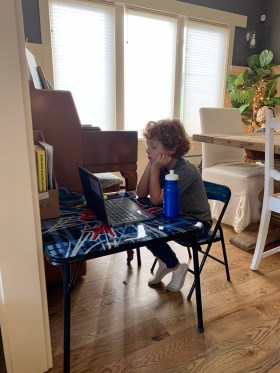
Courtesy of Shalyse OlsonShalyse Olson’s 6-year-old son, Van, sits at his computer during remote kindergarten in Salem, Oregon.
Christy Perry, the superintendent of Salem-Keizer Public Schools, which serves about 42,000 students, understands why parents are frustrated, and she notes that school districts—like parents— aren’t used to dealing with such a sustained disruption to education either. “Usually an emergency is a hurricane, tornadoes, wildfires. They come, you clean up, and they go. In this case, the emergency has come and stayed,” she says.
On Oct. 13, Perry announced that the district would continue remote learning for fourth- through 12th-grade students until February 2021 because the two counties in which the district falls had not met state guidelines for reopening, with a test positivity rate of 7.6% in Polk County and 9.9% in Marion County as of Oct. 11.She’s hoping that students from kindergarten through third grade, for whom guidelines are less stringent, will be able to return to classes earlier.
“I think we do have a responsibility to get more kids back,” Perry says. “We just have to do it when it’s safe.”
Some parents are arguing that should be sooner rather than later.
Jennifer Dale, in Lake Oswego, Oregon, has held rallies calling for in-person learning because her 8-year-old daughter, who has Down syndrome, has felt isolated and has struggled to participate in lessons. She recently began going to school for two hours, twice a week, as part of the district’s expansion of limited in-person instruction.
“The importance of in-person, general education classrooms in my daughter’s life could not be more critical,” Dale wrote in an email to the director of Oregon’s Department of Education, adding: “Lizzie asks me each morning – I want to go to ‘far away school. No more computer school.'”
The problems with remote learning are especially acute for children with special education needs.
“We really feel that our kids deserve better,” says Amy Medling, who is part of a group of parents calling for in-person instruction in Nashua, New Hampshire. Her 11-year-old daughter, a sixth grader in Nashua Public Schools, has an auditory processing disorder that makes it more difficult to follow along on Zoom and decipher who is speaking, especially when multiple people are chiming in. “Pretty much we end up in tears every day at the end of remote learning,” Medling says.
<strong>“Pretty much we end up in tears every day at the end of remote learning.”</strong>Nashua School District Superintendent Jahmal Mosley says he wants to be “safe and methodical” about reopening in a city with rising transmission levels. The district has started welcoming some students back for hybrid learning in phases, starting with some special education and preschool students this month and prioritizing the youngest grades in the coming weeks. High school students would begin hybrid learning in January “if everything goes well.”
Mosley agrees with parents who say remote learning is no replacement for the classroom experience, but it’s one way to keep kids learning during the pandemic. “It’s not perfect. It never will be,” he says. “But it’s a weapon against COVID-19.”
Many teachers’ unions agree and have advocated for continued remote learning,raising safety concernsabout conditions within school buildings and noting that school employees, because of their ages, would be at higher risk of becoming seriously ill from the coronavirus than children.
The issue is pitting parental groups against each other in some cases. Soon after Leslie Hofmeister, who has two children in the San Diego Unified School District, and others began protesting outside the district’s Board of Education office to demand in-person learning, other parentslaunched a petitionurging the district not to fully reopen classes until “it can be safely done using an informed, science-based approach.”
San Diego County is now seeing 7 daily new coronavirus cases per 100,000 residents, nearing the level at which the state prohibits most in-person instruction. The district is currently allowing some students with the most needs to come into schools for limited in-person instruction and is working on a plan to expand hybrid learning to all students.
“I am heartbroken for this generation of kids,” Hofmeister says, calling remote learning “an absolute disaster.” Dawniel Carlock Stewart, who has three children in San Diego schools, disagrees. “While it’s not ideal, we have certainly adjusted to the hard situation and understand that this is what’s best for everyone right now,” she says.
Carlock Stewart worries about how her children would feel if they were allowed back at school and brought the virus home to her husband, whose compromised immune system puts him at high risk of illness. “It would be more detrimental to my children and our family, ultimately, than whether or not they do well in math,” she says.
‘These families are in a bind’
Experts say the lack of national data and clear guidance on school reopenings has made it harder for parents and for schools trying to figure out the best way forward. President Trump, in his final debate with Democratic nominee Joe Biden, insisted Thursday that the virus “will go away.” “We are rounding the turn, we are rounding the corner,” he said, as daily cases continued to rise in the U.S., insisting again that “we have to open our schools.”
The result, for many parents and educators, is mass confusion.
“I think in many places, there’s probably a way to make the schools safe, but often, people don’t even agree on what safe means,” says Whitney Robinson, an associate professor of epidemiology at the University of North Carolina Gillings School of Global Public Health. “And another thing is that there has not been the federal funding to do things that would make all places safe.”
Smith, the Kent State epidemiologist, says the lack of sufficient testing and contact tracing still makes it difficult to determine if outbreaks are directly related to in-school transmission.
And just as Black and Latino communities have been hit hardest by COVID-19, and by its economic impact, they also have the most at stake in the schools dispute. Students of color are more likely to attend high-poverty schools, which have faced the biggest challenges getting buildings ready for safe in-person instruction or supplying students with the computers and internet access needed for remote classes. Parents of color have also been among the most hesitant to send their children back to school, in part because they have been disproportionately affected by the pandemic.
“I think there’s a lot of families, particularly in Black communities, Latino communities, where parents are essential workers and need to work, and not having in-person school can be a hardship,” says Robinson, who studies health disparities by race and ethnicity. “But also, these communities have seen first-hand how awful the coronavirus is.”
“So these families are in a bind,” she says.
Robinson says Congress needs to pass arelief billthat will provide more funding to school districts so they can invest in protective equipment, ventilation systems and testing to enable more schools to open in person.
“It’s doable,” she says. “We just need political will.”