 |
submitted by /u/anutensil [link] [comments] |

How Rising Temperatures Due to Climate Change are Shortening Pregnancies
How Rising Temperatures Due to Climate Change are Shortening Pregnancies
https://ift.tt/2RbUBrV December 03, 2019 at 12:41AM https://ift.tt/1R552o9

The Samoan Government Will Shut Down to Help Stop a Dangerous Measles Outbreak
As the measles virus continues to spread worldwide, Samoan Prime Minister Tuilaepa Lupesoliai Sailele Malielegaoi announced Monday that Samoa will take the dramatic step of closing its government for two days this week to assist with a public vaccination campaign.
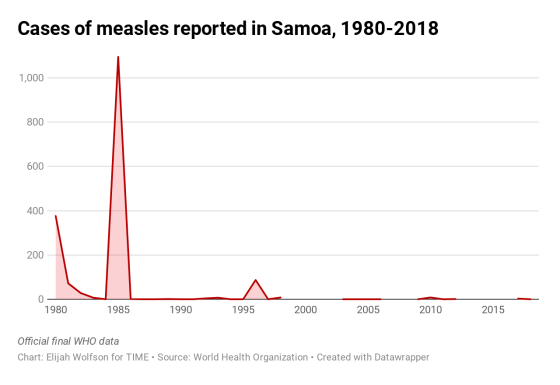
Aside from 2019, Samoa has reported almost no cases of measles to the World Health Organization (WHO) in recent years. But vaccine coverage in the small nation is lacking, partially attributable to public concern following two vaccine-related deaths that occurred in 2018 due to faulty formulas, the WHO reports. As of 2018, only 31% of children had received one of two doses of the measles vaccine, allowing the virus to spread rapidly. A total of 3,728 people, nearly 2% of Samoa’s population, have contracted measles during the current outbreak, including nearly 200 in the past day alone, according to a government statement on Dec. 1. Fifty-three people have died from measles, and the outbreak was declared an emergency on Nov. 15.
To help slow that rapid spread, all schools have been indefinitely closed since Nov. 17, and children have been barred from public gatherings. The country is also coordinating a mass vaccination campaign, with the help of about $72,000 in aid funding from the Red Cross’ Asia Pacific chapter. All government employees, except those who work in water or electric supply, will help orchestrate the campaign on Dec. 5 and 6, CNN reports. More than 58,000 Samoan people have already been vaccinated.
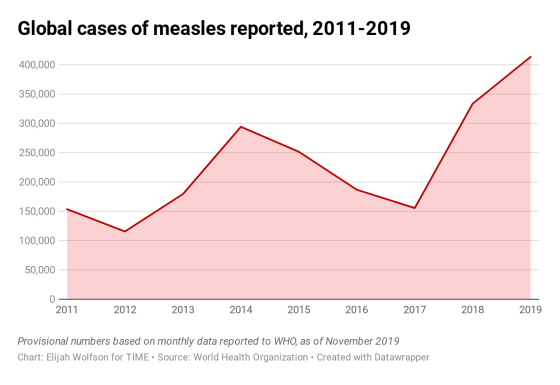
While the measles outbreak in Samoa is particularly dramatic, countries around the globe are experiencing a resurgence of the virus, which starts with minor symptoms like a runny nose and skin rash but can progress to include complications such as brain damage and predispose sufferers to other infections. In 2018, about 350,000 cases of measles were reported globally, more than double the number in 2017, according to UNICEF. And according to provisional WHO data, about 413,000 cases had been reported worldwide as of November 2019.
The WHO has blamed a dangerous rise in vaccine skepticism for the uptick, saying earlier this year that vaccine hesitancy is one of the 10 largest threats to global health. Developed countries, such as the U.S. and France, seem to show the most hesitation toward vaccination, in part due to a widely discredited belief that vaccines can cause autism.
That thinking has become so pervasive in the U.S. that the country came perilously close to losing its measles elimination status this year. The disease was declared eliminated domestically in 2000, but more than 1,200 people have been diagnosed with the virus in 2019—the most in 25 years—leading to emergency declarations in places including New York City and New York’s Rockland County.
Grey's Anatomy episode on sexual assault raised viewer awareness
Grey's Anatomy episode on sexual assault raised viewer awareness
Reuters: Health
(Reuters Health) - An episode of the long-running television show Grey's Anatomy increased public awareness about sexual assault and how to get help, a study suggests.


Reuters: Health
(Reuters Health) - An episode of the long-running television show Grey's Anatomy increased public awareness about sexual assault and how to get help, a study suggests.
I Enjoy My Life So Much More
It’s Monday, everyone! And that means another Primal Blueprint Real Life Story from a Mark’s Daily Apple reader. If you have your own success story and would like to share it with me and the Mark’s Daily Apple community please contact me here. I’ll continue to publish these each Monday as long as they keep coming in. Thank you for reading!

Yup, success stories are back! And I’m looking for more. Follow-ups, mid-progress reflections—every story at every stage has the potential to inspire folks out there who are getting started or contemplating a new beginning. Contact me here to share your story—long or not so long. You never know who you’ll impact by doing it. Enjoy, everyone!
Dear Mark, Thank you for asking for my contribution. And thanks for your unending support, inspiration and courage that you show everyday in your writing, your offering of healthy food, and your very presence.
I was a food addict. I was unhealthy. I didn’t really care.
Interestingly, I had Mark’s Daily Apple on my computer for years and never put it together that it was you or that it could be of any real help to me; some cool ideas….someday. When the stronger inkling of doing something about not feeling so well came up in me (age 65), it was the book Primal Blueprint that was there for me and that I was drawn to. Ultimately, I would need to lower my carbs even more to succeed at weight loss, but I am glad I started with your book because it talked about wonderful things like walking barefoot and volleyball on the beach with young studs. It got me feeling/thinking and opened my perspective on food and life.

The pictures above are the beginning middle and ongoing part of my keto/new lifestyle way of living. I now use fasting and lower carb eating to continue to sculpt and improve and perhaps lose a bit more. I think of it as reshaping and renewing now rather than aging.
I now kayak with people younger than me and train with a gyrotonic instructor a few hours a week. I am 19 months into my new journey.
 Once I made the decision and choice to do keto, and my body switched to burning fat as my fuel instead of carbohydrates, which for me took 3-4 months, when it became easy for me and has been a joy ever since. Let’s see…..eat this piece of bread or FEEL FANTASTIC. No chance, especially since I can have my own bread which I make with all organic ingredients.
I enjoy my life so much more. Food is this glorious celebration after fasting for a bit. I continue to read and tweek things, and the adventure will never end.
This final picture is just for fun. I feel playful now and frisky. Not sure if the world is ready for me……..
Submitted with so much JOY!!!
Paula M.
September 2019
The post I Enjoy My Life So Much More appeared first on Mark's Daily Apple.
How Rising Temperatures Due to Climate Change are Shortening Pregnancies
It’s bad enough that adults have made a climatological mess of the world. It’s worse that the mess is having a disproportionate impact on kids—who did nothing to create the problem, but are more susceptible to health issues caused by rising temperatures than adults are. Now, it appears, global warming is doing its damage even further down the human age spectrum. According to a new study published in Nature Climate Change, rising temperatures may have a direct impact on human gestational time, increasing the risk of early delivery.
Babies are considered premature when they are born at 37 weeks or earlier. But delivery between 37 and 40 weeks is still not considered ideal, with late-term births correlated to lower birthweight and even potential cognitive development problems later in life. Many variables can cause an otherwise healthy pregnancy to come to term earlier than it should—one is extreme heat.
To study this effect, Alan Barreca, an associate professor at UCLA’s Institute of Environmental Sustainability, and economist Jessamyn Schaller of Claremont McKenna College, analyzed daily temperature and county-by-county birth rates across the U.S. in a two-decade window from 1969 to 1988. That is an admittedly old dataset, but the researchers had little choice.
“In 1989, the vital statistics system started to be more cautious about information it allowed out publicly in order to make it hard to identify individuals precisely by place or date of birth,” says Barreca. “They even began masking some counties. So 1969 to 1988 gave us the most thorough information.”
In that dataset, the researchers found that on days when temperatures reached or exceeded 32.2ºC (90ºF), the birth rate per 100,000 women increased by 0.97, compared to dates in which the temperature was between 16-21º C (60-70º F). There was a smaller, but still significant, bump of 0.57 additional births per 100,000 women on days that were hot but not quite as sweltering, ranging from 26.7-32.2º C (80-90º F).
The exact biological mechanism by which heat impacts pregnancy isn’t clear, but there are multiple theories. It’s possible heat leads to cardiovascular stress in the mother that in turn causes the body to go into labor early. Another possibility is that high temperatures may trigger an increase in levels of the hormone oxytocin, which plays a role in both labor and, later, lactation.
“There may even be a third cause,” Barreca says, “which is loss of sleep. Minimum temperature on a hot day occurs at night, but it can still be hot enough to disrupt sleep, and that might be an important avenue to early birth.”
The effect of heat on pregnancy was less pronounced in hot-weather regions like the desert southwest and the deep south, probably because expectant mothers who live in these parts of the country have acclimated to high temperatures. Income makes a difference as well: greater wealth means a greater likelihood of air conditioning in the home, mitigating the pregnancy-shortening effect of temperature. And since, in the U.S., income often breaks down along racial lines, the study found that African-American mothers are somewhat more likely to experience temperature-related early births than white mothers.
Not every early birth is the same, of course, and the women in the study delivered at different points within the 37 to 40-week window. On average, however, Barreca and Schaller calculated that an early birth caused by 90º F or greater temperature cost a woman and her baby 6.1 days of gestation.
Across the entire 20-year period sampled in the study, there were 25,000 early births caused by high temperatures annually. That’s a small share of the 3.5 million babies born per year on average during that time window—but it’s still 25,000 babies every year who didn’t get the growth and developmental benefit of a full 40 weeks.
Troublingly, the problem is only likely to get worse. The 1969 to 1988 period was merely the leading edge of the heat spikes the world has experienced in recent decades. As climate change grows more severe—with eight of the ten hottest years on record occurring just in the last decade—more and more babies are likely to be emerging too early into a too-hot world.
Subscribe to:
Posts (Atom)